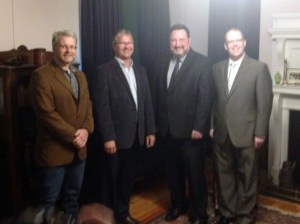
Tim Rast (President, NLAS), Darin King (Minister of Business, Tourism, Culture and Rural Development), John Riche (Chair, Admiralty House Museum, Steve Kent (Deputy Premier)
This morning, Minister Darin King officially announced the contribution of $1.2M in Cultural Economic Development Program (CEDP) funding to 115 heritage organizations across the Province at Admiralty House Museum and Archives in Mount Pearl. The Newfoundland and Labrador Archaeological Society is one of seven organizations to receive part of an additional $39,000 in CEDP funding for heritage projects. This is the pot of money that our Community Collections Archaeology Research Project is funded from. We were invited to attend the announcement and NLAS President, Tim Rast, said a few words about the importance of CEDP funding to the society. Here is a copy of Tim’s comments from the event:

Tim Rast introducing the Community Collections Archaeology Research Project at Admiralty House Museum.
The Newfoundland and Labrador Archaeological Society is a Province-wide not-for-profit organization whose mission is to promote an understanding of archaeology in Newfoundland and Labrador and protect archaeological resources by fostering research, stewardship, education, and the exchange of ideas and information between professionals and the public.
As a rule of thumb, every archaeological site or artifact was once lost. Objects that belonged to living people in the past were dropped or tossed, buried or sunk. They were lost and forgotten. But then someone found them. Sometimes the person who finds them is an archaeologist and the artifact is catalogued, photographed, measured, curated and shared with a wide audience. Sometimes the person who finds them is not an archaeologist and the artifacts are collected and shared with family and friends, but they might not enter into the bigger archaeological story of the province. Those artifacts might not have the chance to contribute to the story of Newfoundland and Labrador and in a sense, they are lost a second time.
That’s where the Cultural Economic Development Program comes in. Through CEDP funding, the Newfoundland and Labrador Archaeological Society can operate the Community Collections Archaeology Research Project, or CCARP. This project seeks to bring privately held archaeological collections in the Province out of shoeboxes, closets, and basements and showcase them for everyone in the Province to learn from and enjoy. We use CEDP funding to employ an archaeologist to work with a private collector to analyze, record, and present a private collection to a wider audience. The end result is a full colour report and an online gallery on the NLAS website. Records of the artifacts are submitted to the Province, so that the next time a student or professional archaeologist is studying a particular area, culture or time period, the information will be available for them to include in their research. The artifacts themselves and a copy of the report are returned to the collector.
The goal is not to encourage the private collection of artifacts, in fact, the Province’s Historic Resources Act says that you must have an archaeology permit to even look for artifacts. Rather we want to gain a better understanding of important collections that may not be curated by archaeologists or museum professionals in the Province.
Archaeological artifacts have survived incredible odds to have been lost and found once. It is our goal to find, record, and share those objects before they are lost a second time and to record the memories and contribution of the people who discovered them and make them available to everyone. For the past two years, we’ve been able to accomplish that through funding provided by the Cultural Economic Development Program for which we are very grateful. Thank you.
Photo Credits: Lori White


 Newfoundland And Labrador Archaeological Society