CALL FOR NOMINATIONS: The NLAS is now accepting nominations for the following positions: President, Vice-President, and Treasurer. Please see the attached form for instructions. If you would like more information about the elections process or the positions, please email the Elections Committee at nlas@nlarchsociety.ca. An outline of the duties for each position is also available in the NLAS constitution located on our website. Newly elected officers will resume their duties on January 1st. Deadline for submissions is October 15th.
The Dirt on Your Directors: Vice-President Catherine Jalbert
Since the current Board of the NLAS is also its first formal Board and there is an AGM coming up in November where many of these people will be replaced, we thought it would be interesting to get each board member to answer a series of questions about themselves and their role with the NLAS. Over the next few weeks we will post each board members response to those questions. Up next is Vice-President Catherine Jalbert.
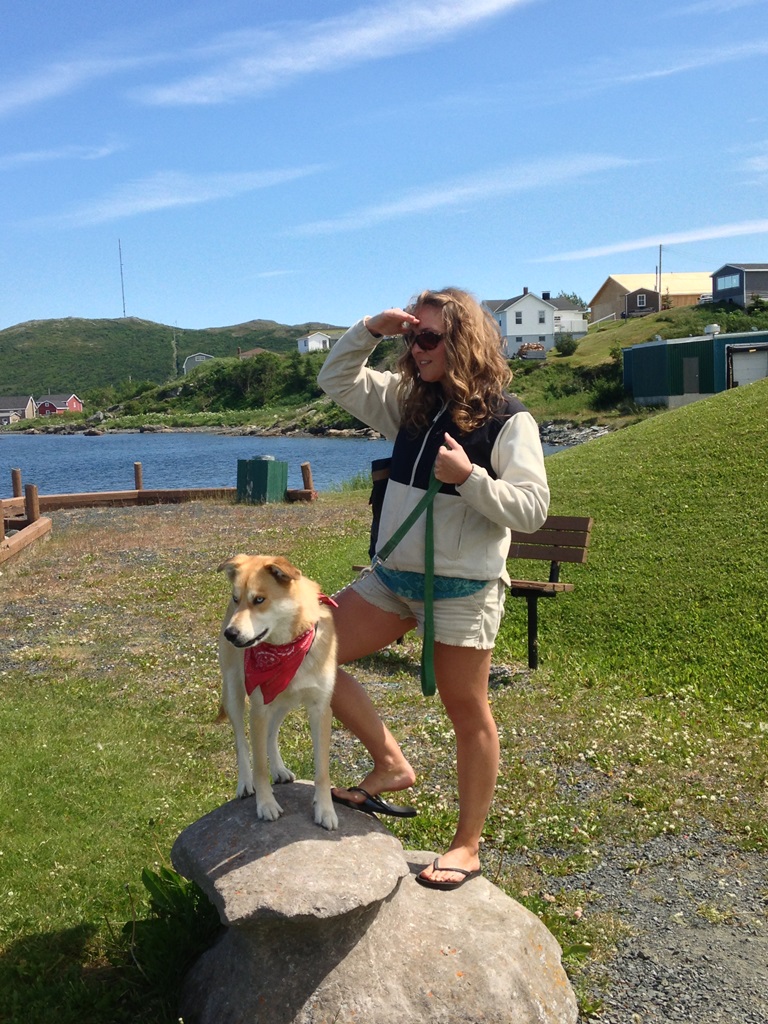
Catherine and Willie
How did you get interested in Archaeology?
- I initially became interested in archaeology when I was in high school. I loved history and social studies but I wanted to find a way to apply that love to something I considered to be more “hands-on”. That’s when I discovered archaeology. I liked the idea of the dual components of research and fieldwork so I decided to pursue it when I enrolled at my undergraduate university even though I hadn’t really had any field experience. I was hooked after my first semester of classes and once I took my field school, I knew it was for me. I discovered I love fieldwork, even when weather conditions are less than ideal.
What sort of things do you do as Vice-President?
- As Vice-President of the NLAS, I was the Chair of the Events Committee until last December when I relocated from the province. The Events Committee is responsible for various programming for NLAS members and the public, which can include workshops, talks and field trips.
As an Executive or Board member you are not limited to certain committees so I try to help out in other areas when I can. I am currently also serving on the 2015 Symposium Committee and am Chair of the Elections Committee for our upcoming Annual General Meeting.
(Shameless plug: If you have any interest in running for a position, please send the Elections Committee an email at nlas@nlarchsociety.ca!)
What was the most interesting artifact(s)/site you found/worked on?
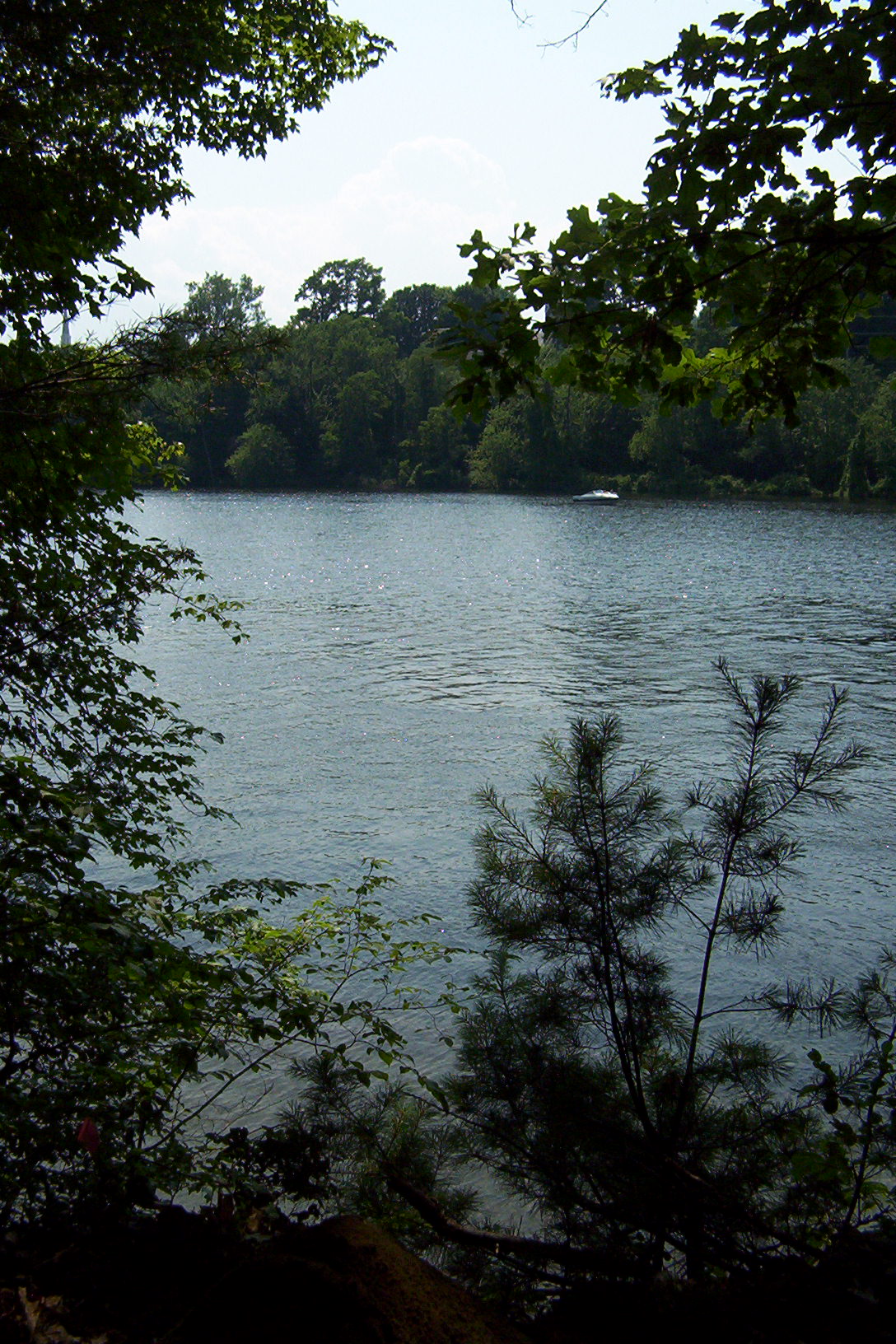
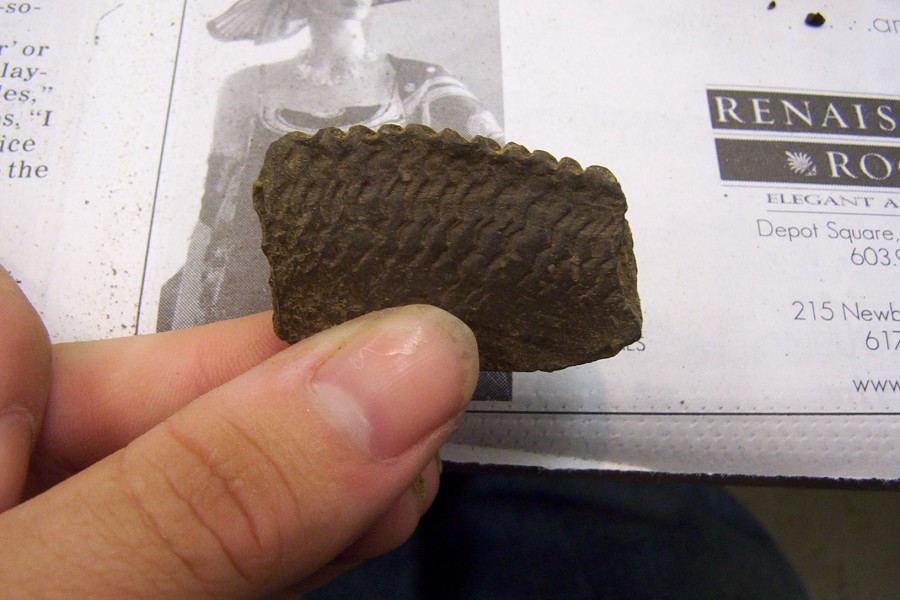
- I decided to combine these questions because the most interesting site I worked on also yielded the most interesting artifacts. The site was a large multi-component site situated on the Connecticut River in New Hampshire. A large portion of it had already eroded into the river when we began excavations there in 2004 but it still turned out to be a very rich site where we discovered a number of artifacts including a complete ground stone axe, a cache of preforms (to later be reduced into stone tools), and a large sample of decorated pottery.
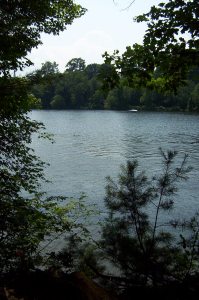
Connecticut River in New Hampshire.
Pottery from the Connecticut River site in New Hampshire.
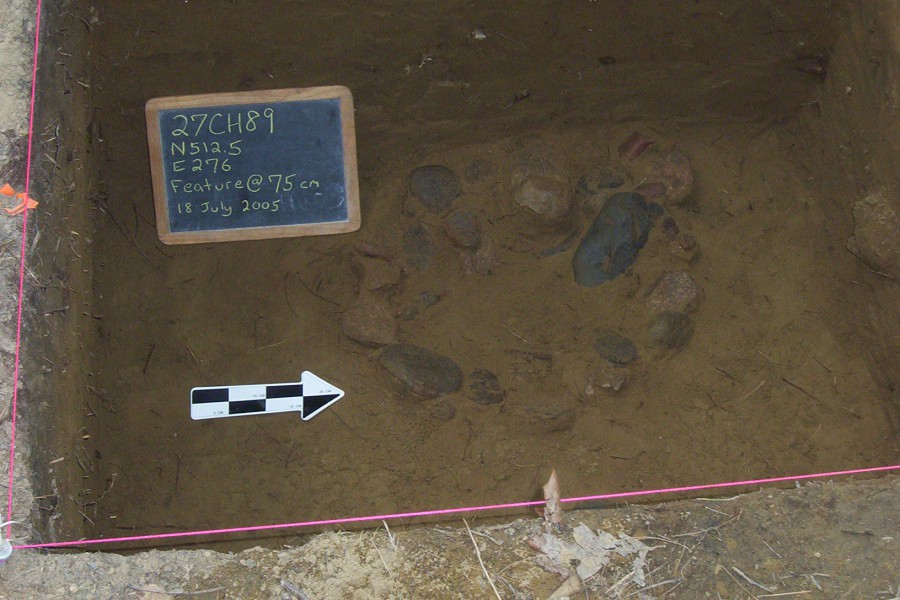
Although I can’t take credit for it’s discovery (since I was working in another unit), the most interesting artifact that I saw at this site actually wasn’t an artifact at all—it was a hearth feature. It was in perfect condition and yielded a lot of useful information about the subsistence strategies of the people that inhabited this site during the Late Archaic (5000-3000 BP), the time period the hearth was later dated to.

Hearth feature from the Connecticut River site in New Hampshire.
If you could give yourself one piece of advice to help you along your archaeology path, what would it be?
- Don’t wait for paid opportunities if you are really interested in pursuing archaeology as a career. Get as much volunteer experience as you can, whether that is at your university, in a museum, or with a local organization. As much as I want this to be a shameless plug for the NLAS, it really isn’t! There is so much you can learn from volunteering that you won’t get in the classroom and although it is nice to be paid, volunteering and getting involved with your community shows that you have a keen interest to learn and to widen your skillset.
What made you want to get involved with the NLAS?
- I wanted to get involved in the NLAS because I thought it was important that the province had an organization to connect people from a variety of backgrounds through their interest in archaeology. Organizations like the NLAS are vital to developing stewardship by fostering relationships with professionals and communities to educate and preserve the rich cultural history of the province. I’m proud of what the NLAS has accomplished so far and I’m excited to see what the future holds for our Society.
Symposium In Honour of the 100th Anniversary of James P. Howley’s book, “The Beothucks or Red Indians”
In his 1993 article Archaeology, History, and the Beothuks, Ralph Pastore, in reference to Howley’s book wrote: “For forty years he collected published works, maps, newspaper accounts, government documents, personal papers and oral traditions pertaining to the Beothuks. The result was his monumental collection, The Beothucks or Red Indians (1915).“
The Newfoundland and Labrador Archaeological Society invites you to attend our Symposium In Honour of the 100th Anniversary of James P. Howley’s book, “The Beothucks or Red Indians”.
In 1915, James P. Howley published what is still regarded as one of the most important works on the Beothuk. This symposium will gather some of the foremost Beothuk research specialists in archaeology, history, and historic site tourism, to introduce Howley’s book and discuss the contributions that this volume has made to our understanding of the Beothuk people and culture.
We welcome everyone to celebrate this special milestone in Newfoundland and Labrador archaeology with us. Stay tuned as we announce our full roster of panellists over the coming weeks!
FREE PUBLIC EVENT. All are welcome. Wheelchair accessible.
Date: Thursday, November 5, 2015
Time: 7:00 p.m. – 8:30 p.m.
Doors open at 6:40 p.m. Seating is limited.
There will be a 20-minute intermission at the end of the symposium before we begin our Annual General Meeting. The public is welcome to stay and attend our brief AGM from 8:50 p.m. – 9:30 p.m.

The Dirt on Your Directors: Director Chris Wolff
Since the current Board of the NLAS is also its first formal Board and there is an AGM coming up in November where many of these people will be replaced, we thought it would be interesting to get each board member to answer a series of questions about themselves and their role with the NLAS. Over the next few weeks we will post each board members response to those questions. Up next is Dr. Chris Wolff, a member of our Board of Directors.
How did you get interested in Archaeology?
- I don’t really remember a time when I wasn’t interested in Archaeology, although there was certainly a time when I didn’t know the name for it. Growing up on a ranch in Texas I was always finding stone tools and wondering about who made them. But only after my first year at University, when I noticed all of the electives I wanted to take were in the Anthropology Department, and archaeology was my main interest, did I make the choice to pursue archaeology.
What sort of things do you do as a board member?
- I mostly provide my perspective on various issues and questions concerning the future of the NLAS and archaeology more generally in the Province. I think as a CFA I can provide a different viewpoint that is sometimes helpful. I do this at various scheduled meetings and through social media. I usually attend the meetings virtually from my office in Plattsburgh, New York.
Do you have a favourite site or artifact from the Province?
- My favorite site is the Stock Cove Site (CkAl-03) where I have been working since 2008. In 2009, Don Holly and John Erwin began collaborating with me at the site, along with various students and community members over the years. The site is large and has evidence of almost every culture that inhabited Newfoundland. The primary component, however, is the large Dorset Palaeoeskimo presence. Thousands of their artifacts have been recovered to date, and several architectural features have been documented. Only a small part of the site has been investigated so far.
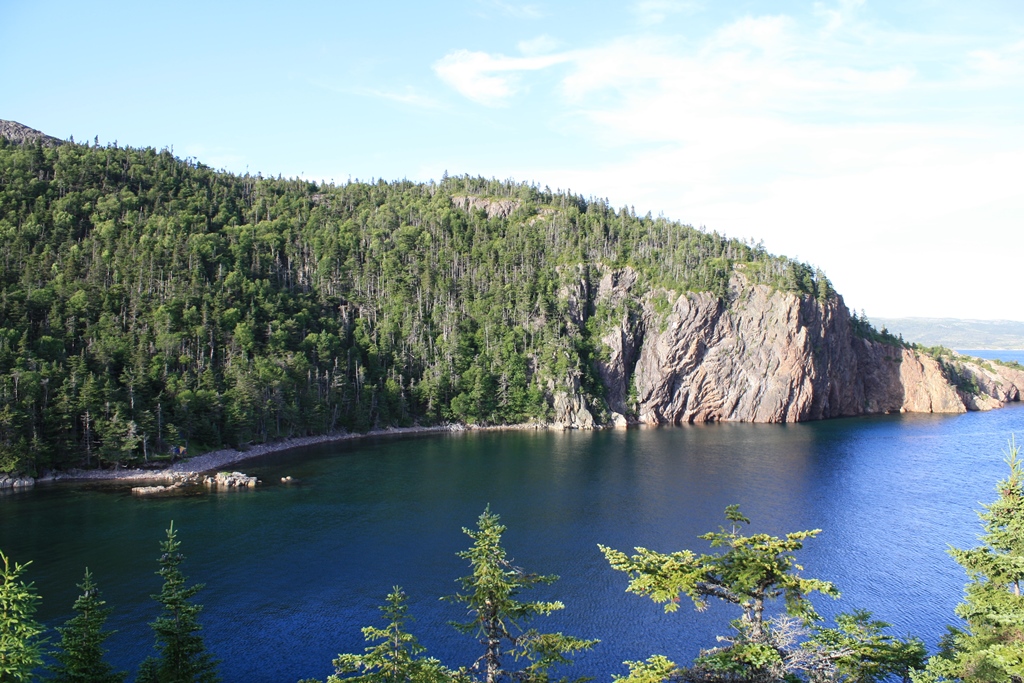
Looking towards the Stock Cove site.
What was the most interesting site you have worked on?
- The most interesting site I have worked on in Newfoundland is the Stock Cove Site, but I have a broad range of experience working at Viking Age sites in Iceland, early Palaeoeskimo sites in Alaska, Paleoindian sites in Colorado and Texas, and even a very early site in Egypt’s Sahara Desert.

Gradation of endblades from the Stock Cove site.
In your opinion, what is the one thing that no archaeologist should be without?
- A toothbrush. Actually two. One for your actual teeth while in the field, and the other for fine excavation and cleaning of sensitive artifacts.
If you could give yourself one piece of advice to help you along your archaeology path, what would it be?
- Get as many types of experience within the field as possible. Make yourself ready for opportunities when they arise, and find time to read the literature.
What made you want to get involved with the NLAS?
- Ever since I first began working in Newfoundland and Labrador in 2001 I have loved the place. The diverse prehistory and history of the region is incredibly interesting and should find a broader audience. The goal of the NLAS to reach out to communities and create partnerships between professional archaeologists and the public is something I strongly believe in and I felt I should do what I could to support that.
When I think about the future of the NLAS, I hope………
- It continues to grow and makes a lasting contribution to our collective knowledge of the history of the Province.
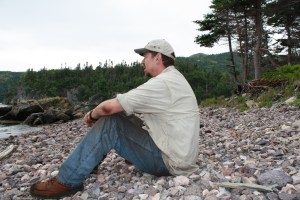
Dr. Wolff pondering the Dorset presence at Stock Cove.

The Dirt on Your Directors: Communications Committee, Stephen Hull
Since the current Board of the NLAS is also its first formal Board and there is an AGM coming up in November where many of these people will be replaced, we thought it would be interesting to get each board member to answer a series of questions about themselves and their role with the NLAS. Over the next few weeks we will post each board members response to those questions. Up next is Stephen Hull, a member of the Communications Committee.
How did you get interested in Archaeology?
- My father instilled in me an interest in the past of Newfoundland and Labrador. I took that interest to University and majored in History and Geography. In the midst of finishing that degree I became more interested in earth sciences and fossils. While looking at the Memorial University calendar I came across Archaeology. That fall I started my first archaeology course and I’ve been working in the field ever since.
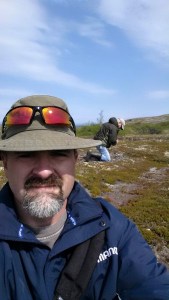
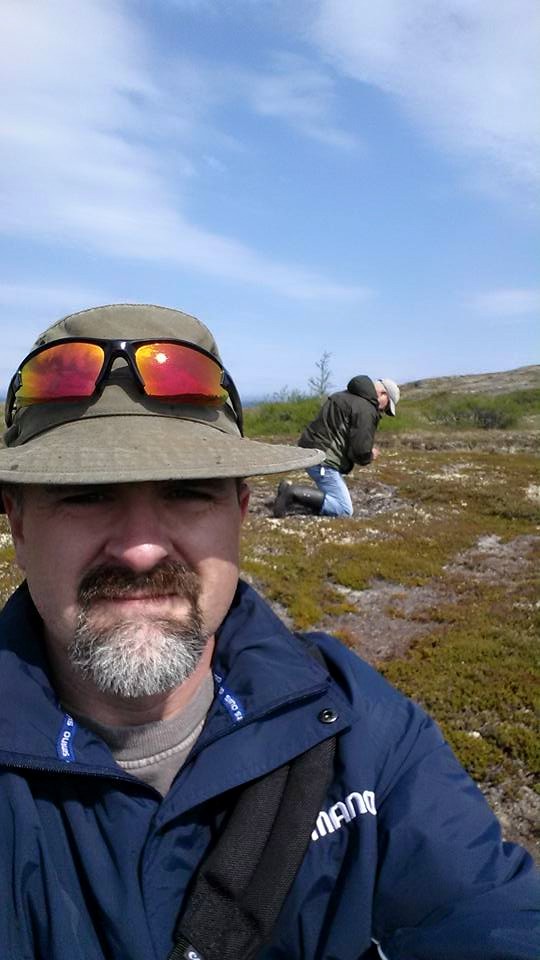
During a work visit to a known eroding site this summer, 2015. I am taking photos and dad is surface collecting artifacts from an eroding site.
Do you have a favourite site or artifact from the Province?
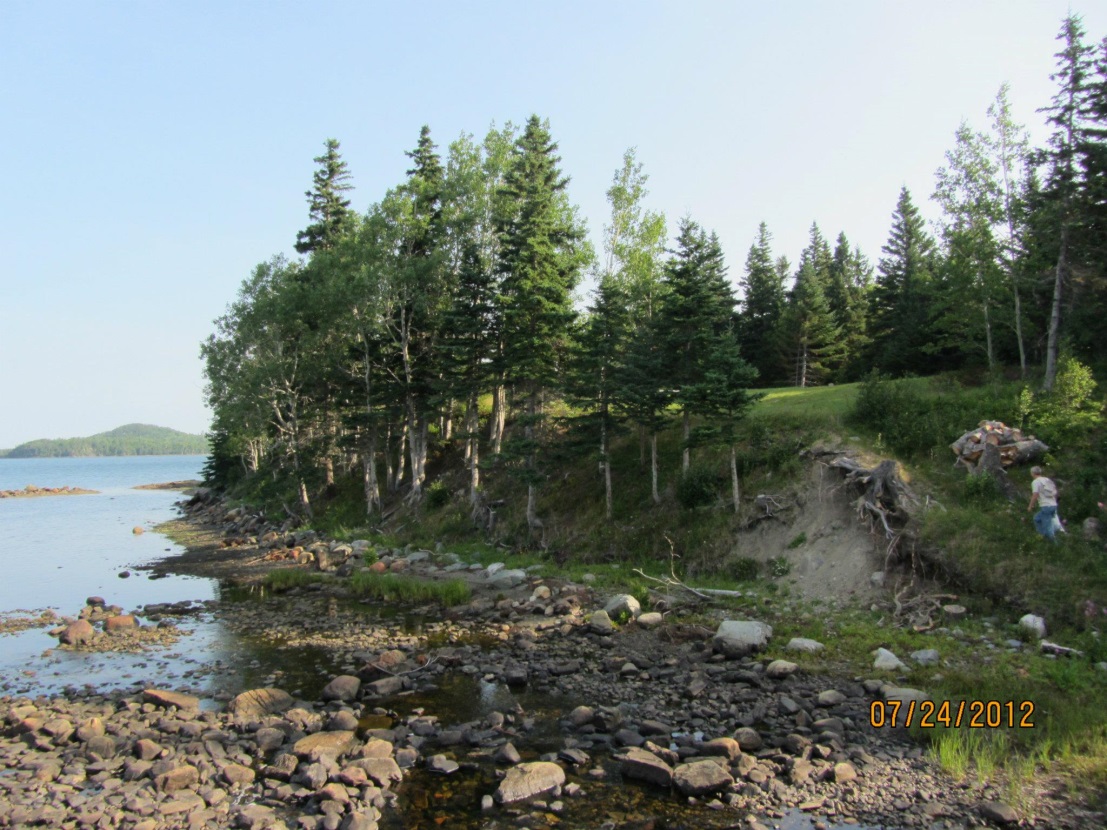
- Working for the Provincial Archaeology Office has given me the opportunity to visit a lot of sites in NL. While they all have their interesting points, there are several that I am partial too. If I had to pick one site it would have to be Boyd’s Cove for a number of reasons. First of all it’s a Recent Indian – Beothuk habitation site, my main area of research interest. Second, the site is the key to showing that the precontact Recent Indian culture sequence of Beaches complex (~2000-1000BP) to Little Passage complex (~1000 BP-European contact) was the precontact ancestors of the Beothuk. Third, I think the site is beautiful with several visible Beothuk housepits and a nice view from the terrace it sits on looking out over the water. Finally, the site is now part of a Provincial Historic Site called the Beothuk Interpretation Centre and it has a knowledgeable and super friendly staff.
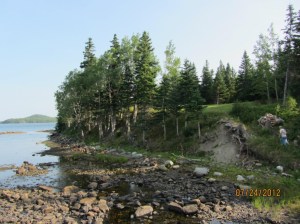
Boyd’s Cove is on the terrace on the right of the photo.
- Working for the Provincial Archaeology Office has given me the opportunity to visit a lot of sites in NL. While they all have their interesting points, there are several that I am partial too. If I had to pick one site it would have to be Boyd’s Cove for a number of reasons. First of all it’s a Recent Indian – Beothuk habitation site, my main area of research interest. Second, the site is the key to showing that the precontact Recent Indian culture sequence of Beaches complex (~2000-1000BP) to Little Passage complex (~1000 BP-European contact) was the precontact ancestors of the Beothuk. Third, I think the site is beautiful with several visible Beothuk housepits and a nice view from the terrace it sits on looking out over the water. Finally, the site is now part of a Provincial Historic Site called the Beothuk Interpretation Centre and it has a knowledgeable and super friendly staff.
What was the most interesting artifact(s) you found?
- A few discoveries stick out in my mind. I still recall finding my first artifact. We were shovel testing a site on the west coast of Newfoundland near Cox’s Cove. We didn’t know for sure at the time but the site had Groswater and Dorset Palaeoeskimo components and a Beothuk component. I can still recall turning over the shovel full of dirt and seeing the chocolate brown coloured artifact. If I remember correctly the artifact was part of a scraper, I was so excited because I found my first artifact and, more importantly, I knew enough to recognize it!
- I think one of the most interesting artifacts I ever found was on the same site. We had been excavating a Groswater house pit and I had been finding a lot of seal bone. One of the small pieces of bone I pulled out of the ground turned out to be a bone sewing needle, or at least part of a needle.
If you could give yourself one piece of advice to help you along your archaeology path, what would it be?
- Volunteer and get involved. I volunteered at the former Newfoundland Museum on Duckworth Street and the experience was invaluable. While I was never involved in things like MUNArch or the NLAS, looking back on it now it is one of the things I regret. Volunteering in these organizations is a foot in the door with people you may be working with in the future.
How to Apply for Grad School
Do you have questions about applying for graduate school?
The Newfoundland and Labrador Archaeological Society may be able to help. We are having an Archaeology Skills Workshop where you will learn the do’s and dont’s of applying to graduate school.

How to Apply to Grad School
The Dirt on Your Directors: Chair of the Planning Committee, John Erwin
Since the current Board is also the first formal Board for the NLAS and there is an AGM coming up in November where many of these people will be replaced, we thought it would be interesting to get each board member to answer a series of questions about themselves and their role with the NLAS. Over the next few weeks we will post each board members responses to those questions. In no particular order, up first is Dr. John Erwin.
How did you get interested in Archaeology?
- I became interested in archaeology after taking a field school at Dundurn Castle in 1992 while I was an undergraduate student at McMaster University in Hamilton Ontario.
What things do you do as the chair/member of the ________ Committee?
- As the Chair of the Planning Committee I have helped develop the NLAS activity Plan and the Society’s Annual Report. I have continued to work closely with the executive of the society to monitor our activities to help ensure that the goals and objectives of the society are met.
Do you have a favourite site or artifact from the Province?
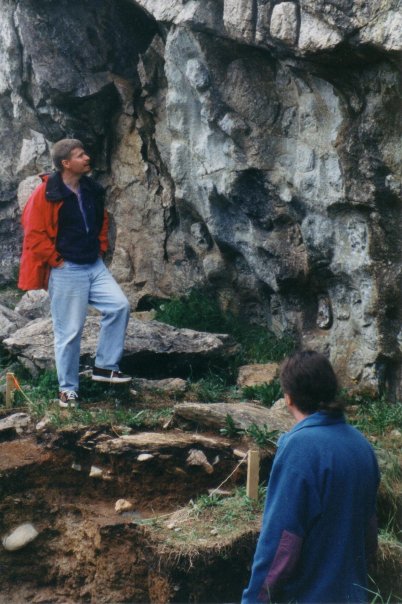
- My favourite site in the province is Fleur de Lys 1 (the Dorset soapstone Quarry in Fleur de Lys). This is a large and well-preserved prehistoric soapstone quarry with over 650 visible removal scars preserved in the main exposed soapstone out crop. These carvings are testimony to the quarry’s 500 year use, which began approximately 1600 years ago and which provided the raw materials for the manufacture of cooking pots and oil lamps.
John & crew chief Brent look at the Fleur de Lys quarry wall.
What was the most interesting artifact(s) you found?
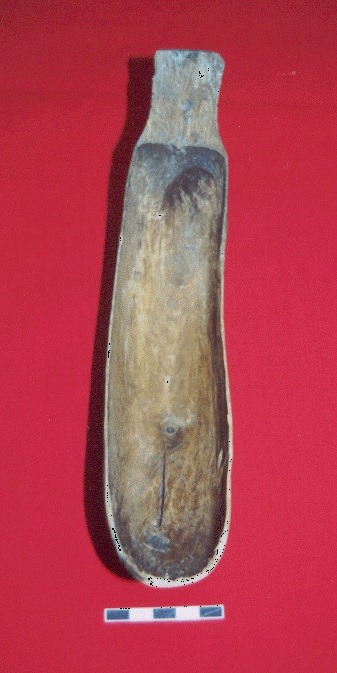
- A 1600 year old Dorset wooden ladle (actually found by my crew chief Brent Murphy) approximately 1.5m below ground the surface adjacent the cliff face of the Fleur de Lys soapstone quarry in 1998.
1600 year old Dorset Palaeoeskimo wooden ladle.
Hant’s Harbour Fieldtrip Report
On August 22, 2015, the Newfoundland and Labrador Archaeological Society organized our first field trip. We traveled to Hant’s Harbour to view the substantial stone features running north of the community. Local tradition refers to these stone mounds and walls as Beothuk or even Maritime Archaic burial mounds or caribou drive lanes which were re-purposed and dismantled by later European settlers in the area (Trinity Stones, Facebook). Archaeologists have investigated the remains and the construction details, archival research, and artifacts associated with the features point to a predominantly 19th century European origin of the features as the result of road building, garden clearing, cellar building, and the like (Penney 2014). Despite the lack of any evidence for a Pre-Contact origin to any of the stone work, they are still remarkable archaeological features and well worth the visit.
We had beautiful weather and the 17 participants (and one dog!) thoroughly enjoyed the sites and sounds on our walk through the woods north of picturesque Hant’s Harbour. The NLAS wishes to thank Grant Tucker for his animated tour of the features and all of the thoughtful discussion that flowed out of the afternoon.
For more information on the archaeology of Hant’s Harbour, you can read The Beothuk and Hant’s Harbour Wall on the Inside Newfoundland Archaeology Blog.
Attached to the photo below is our report on this trip.

Click the photo to download a PDF of our report on the trip to Hant’s Harbour.
References:
Penney, Gerald
2014 Hants Harbour Stone Features, Historic Resources Assessment, Archaeological Investigation Permit #13.48. Report submitted to Provincial Archaeology Office, Government of Newfoundland and Labrador. St. John’s
Trinity Stones Facebook Page: https://www.facebook.com/trinitystones
Hant’s Harbour Field Trip 2015
On August 22, 2015, the Newfoundland and Labrador Archaeological Society organized our first field trip. We traveled to Hant’s Harbour to view the substantial stone features running north of the community. Local tradition refers to these stone mounds and walls as Beothuk or even Maritime Archaic burial mounds or caribou drive lanes which were re-purposed and dismantled by later European settlers in the area (Trinity Stones, Facebook). Archaeologists have investigated the remains and the construction details, archival research, and artifacts associated with the features point to a predominantly 19th century European origin of the features as the result of road building, garden clearing, cellar building, and the like (Penney 2014). Despite the lack of any evidence for a Pre-Contact origin to any of the stone work, they are still remarkable archaeological features and well worth the visit.
We had beautiful weather and the 17 participants (and one dog!) thoroughly enjoyed the sites and sounds on our walk through the woods north of picturesque Hant’s Harbour. The NLAS wishes to thank Grant Tucker for his animated tour of the features and all of the thoughtful discussion that flowed out of the afternoon.
For more information on the archaeology of Hant’s Harbour, you can read The Beothuk and Hant’s Harbour Wall on the Inside Newfoundland Archaeology Blog.
References:
Penney, Gerald
2014 Hants Harbour Stone Features, Historic Resources Assessment, Archaeological Investigation Permit #13.48. Report submitted to Provincial Archaeology Office, Government of Newfoundland and Labrador. St. John’s
Trinity Stones Facebook Page: https://www.facebook.com/trinitystones
NLAS Receives Heritage Sector Support from the Cultural Economic Development Program

Tim Rast (President, NLAS), Darin King (Minister of Business, Tourism, Culture and Rural Development), John Riche (Chair, Admiralty House Museum, Steve Kent (Deputy Premier)
This morning, Minister Darin King officially announced the contribution of $1.2M in Cultural Economic Development Program (CEDP) funding to 115 heritage organizations across the Province at Admiralty House Museum and Archives in Mount Pearl. The Newfoundland and Labrador Archaeological Society is one of seven organizations to receive part of an additional $39,000 in CEDP funding for heritage projects. This is the pot of money that our Community Collections Archaeology Research Project is funded from. We were invited to attend the announcement and NLAS President, Tim Rast, said a few words about the importance of CEDP funding to the society. Here is a copy of Tim’s comments from the event:
Tim Rast introducing the Community Collections Archaeology Research Project at Admiralty House Museum.
The Newfoundland and Labrador Archaeological Society is a Province-wide not-for-profit organization whose mission is to promote an understanding of archaeology in Newfoundland and Labrador and protect archaeological resources by fostering research, stewardship, education, and the exchange of ideas and information between professionals and the public.
As a rule of thumb, every archaeological site or artifact was once lost. Objects that belonged to living people in the past were dropped or tossed, buried or sunk. They were lost and forgotten. But then someone found them. Sometimes the person who finds them is an archaeologist and the artifact is catalogued, photographed, measured, curated and shared with a wide audience. Sometimes the person who finds them is not an archaeologist and the artifacts are collected and shared with family and friends, but they might not enter into the bigger archaeological story of the province. Those artifacts might not have the chance to contribute to the story of Newfoundland and Labrador and in a sense, they are lost a second time.
That’s where the Cultural Economic Development Program comes in. Through CEDP funding, the Newfoundland and Labrador Archaeological Society can operate the Community Collections Archaeology Research Project, or CCARP. This project seeks to bring privately held archaeological collections in the Province out of shoeboxes, closets, and basements and showcase them for everyone in the Province to learn from and enjoy. We use CEDP funding to employ an archaeologist to work with a private collector to analyze, record, and present a private collection to a wider audience. The end result is a full colour report and an online gallery on the NLAS website. Records of the artifacts are submitted to the Province, so that the next time a student or professional archaeologist is studying a particular area, culture or time period, the information will be available for them to include in their research. The artifacts themselves and a copy of the report are returned to the collector.
The goal is not to encourage the private collection of artifacts, in fact, the Province’s Historic Resources Act says that you must have an archaeology permit to even look for artifacts. Rather we want to gain a better understanding of important collections that may not be curated by archaeologists or museum professionals in the Province.
Archaeological artifacts have survived incredible odds to have been lost and found once. It is our goal to find, record, and share those objects before they are lost a second time and to record the memories and contribution of the people who discovered them and make them available to everyone. For the past two years, we’ve been able to accomplish that through funding provided by the Cultural Economic Development Program for which we are very grateful. Thank you.

Photo Credits: Lori White
 Newfoundland And Labrador Archaeological Society